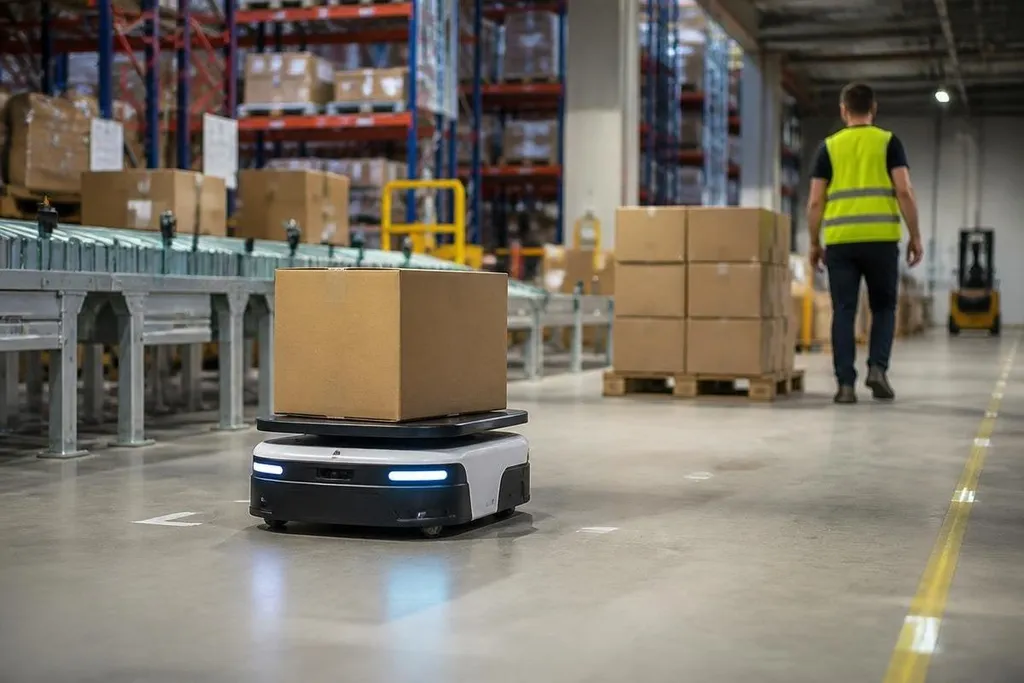
A warehouse robot used to follow fixed routes and repeat fixed motions. AI lets it read sensor data, choose an action, and adjust when a box, person, or pallet is somewhere the program did not expect.
Quick read
- Computer vision helps a robot identify items, gaps, labels, and obstacles.
- Planning software lets one robot choose its next move from live sensor data.
- The hard limit is still reliability around new items, poor lighting, and people.
From fixed routes to live decisions
Older automation works well when the floor, shelf, and item stay in the same place. A change in layout can require new maps, new rules, or a technician’s visit.
AI changes the decision layer. Cameras, LiDAR, and other sensors send data to software that estimates where the robot is and what sits around it. This process is called perception: the robot turns raw sensor readings into useful information.
The robot can then select a route or action from that information. A mobile robot may slow down near a person, drive around a blocked aisle, or choose a different approach to a storage location.
That does not make the robot independent of rules. Safety limits still decide where it may drive and how fast it may move.
Picking items is a harder test
Moving a shelf is easier than picking a loose item. A shelf has a known shape and a fixed position. A tote may contain objects at different angles, with some items partly hidden under others.
Computer vision gives the robot an image of the tote. A model can estimate an item’s shape and position, then select a grasp point for the gripper. The robot still needs force control, which adjusts motor effort when the item slips, bends, or weighs less than expected.
That link between sight and movement matters to warehouse staff. A robot that identifies the correct box but grips the wrong edge still creates a manual recovery task. The useful measure is completed picks, not the number of items the camera can label.
AI also changes fleet software
One robot can make a local choice. A fleet needs to decide which robot should take which job and how those robots share space.
Fleet software can assign work from live location data, battery state, and task priority. It may send a robot to charge before its battery runs low, or give a nearby robot the next transport job. The exact result depends on the software rules, sensor quality, and layout.
When a fleet system sends a robot to charge before a task, the useful question is whether a real site gained time or only changed the schedule. Robot24 can connect that software choice to a named warehouse, robot, company, and deployment date, giving you facts to weigh before the next section covers the testing and network work these systems need.
The gain is less manual coordination. The cost is a larger software system that needs testing, updates, network access, and a clear way to recover from bad decisions.
Where the claims meet the floor
AI handles known patterns better than unknown ones. A model trained on brown cartons may need more work when packaging changes to reflective plastic. A camera can also lose useful detail when glare, dust, shadows, or a crowded tote affects the image.
People create another hard case. A worker can move in a way the robot did not predict, so the system needs safe stopping rules and enough time to react. A smooth demo does not prove that the same task will run through a full shift without human help.
The open question is repeatability. A warehouse manager needs the robot to make the right choice across many items and many hours, not only during a controlled test. I'd judge any AI warehouse system by its recovery work first: how often a person must fix a failed pick, blocked route, or wrong handoff.
A practical buying checklist
Use these checks before you compare an AI feature with a real warehouse need:
- Name the task: record the item types, shelf heights, tote sizes, and handoffs involved.
- Test change: add new packaging, altered lighting, and blocked paths to the trial.
- Count recovery: log every human intervention and the reason for it.
- Check safety: confirm stop zones, speed limits, warning signals, and restart steps.
- Review the data: ask what the system stores, where it runs, and who can change its rules.
- Set the handoff: define when a worker takes control and how the robot reports failure.
These checks move the discussion from an AI label to a work result. They also show where a fixed automation system may still be the better fit, especially when the layout and item flow rarely change.
AI gives warehouse robots more ways to react, but it does not remove the need for good layouts, safe controls, and measured trials. The next useful proof is a record of recovery work over a full operating period, with the task, failure, and human response logged each time.